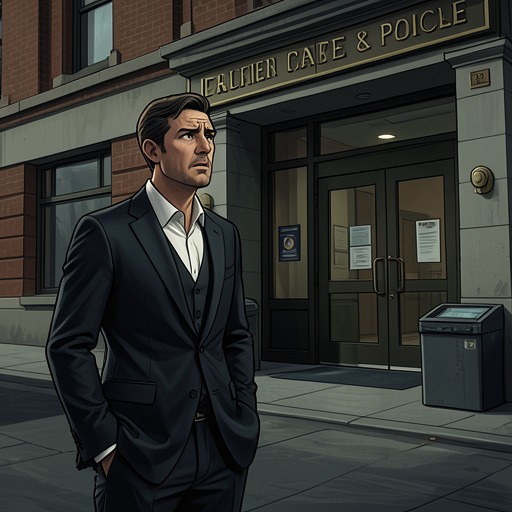
Tom resigns from the police
My PolicemanTom Burgess’s resignation from the police is a consequential retreat from a profession that had shaped both his public identity and his secret relationship with Patrick Hazlewood. After Patrick is arrested, Tom leaves the force before Patrick’s trial. The departure follows a moment of panic when Tom sees Patrick being brought in, and it protects Tom from the scrutiny that the case might otherwise have brought. Yet resignation does not resolve the damage: it changes his livelihood, intensifies the silence in his marriage to Marion Burgess, and becomes one of the costs of the scandal surrounding Patrick.
Background and Pressure
Tom’s position as a police officer made his relationship with Patrick especially precarious. Patrick’s account describes their intimacy developing around encounters at Tom’s police box, while his diary later recorded the relationship in language that would become incriminating in court. Their private attachment thus existed alongside the authority and public respectability Tom’s occupation required him to uphold. The danger was not only that his private life might be exposed; exposure could also reach his job and reputation.
That danger was sharpened by the public scandal involving senior officers in the Brighton Criminal Investigation Department. On 25 October 1957, Patrick recorded that the Chief Constable and a detective inspector had been charged with conspiracy. He initially welcomed the prospect of powerful officers facing public disgrace, but then worried that ordinary, honest members of the force would bear the pressure created by their superiors’ conduct. His concern places Tom’s later departure in a force already under scrutiny, though the account does not establish that the corruption case directly caused Tom to resign.
The immediate crisis came with Patrick’s arrest. Marion’s retrospective account connects it to the consequences of her anonymous letter to Mr Houghton, which she had written without considering what exposure could mean for her husband. Tom told her that he had been present when Patrick was brought in: he saw Slater holding Patrick by the wrist, then got away before Patrick could see him. The encounter made the risk intimate and immediate. Tom was no longer contemplating the possibility of exposure from a distance; he had witnessed the arrest himself.
Resignation Before the Trial
In the aftermath, Marion recognized that her attempt to destroy Patrick had also placed Tom at risk. Tom was overwhelmed by what had happened, and Marion describes him weeping repeatedly in the following weeks. Their response was not an open discussion of the relationship or its consequences. At night she comforted him, while by morning they resumed their ordinary routines without speaking about his crying, the destruction of furniture, or Patrick’s name. The resignation took place within this strained, largely unspoken domestic aftermath.
Before Patrick’s case went to court, Tom did as Marion had suggested and resigned from the force. Her account presents the timing as important: he left before the trial, rather than waiting for the proceedings to force a decision upon him. Later, when Patrick asks about Tom’s absence, Marion says that he left before he was pushed. That explanation characterizes the departure as an attempt to get ahead of pressure, though the book does not describe the formal resignation process or identify a specific order requiring him to leave.
Tom’s departure also occurs against the background of Patrick’s trial and its public disclosure of their relationship. Passages from Patrick’s journal, including his description of Tom as “my policeman,” were read aloud in court. Marion remembers the phrase as a striking conjunction: it named both Patrick’s attachment and Tom’s profession, bringing together the private relationship and the public role Tom had abandoned. She says the words stayed with her, and that Patrick had been right about the relationship’s significance.
Consequences for Work and Marriage
The resignation did not lead to an immediate return to the life Tom had known. In one conversation, Marion tells Patrick that Tom has left the force and is working as a security guard at Allan West’s; she adds that the pay is lower and that she is still working. Her later account says that about a month after the trial he found work as a factory security guard on night shifts. Together, these details establish his move into security work after leaving the police, while the accounts give different descriptions of the particular post. The reduced income and night schedule make the practical consequences plain: the change was not simply a symbolic escape from the force.
Tom’s departure also coincided with his avoiding investigation. Despite the passages from Patrick’s journal, he escaped any investigation, and Marion suspects the force was willing to let him go quietly. In her reading, the authorities had reason to avoid another public scandal after the earlier reports of corruption among senior officers. This remains her interpretation rather than a confirmed account of the force’s deliberations, but it links Tom’s quiet exit to the institution’s wish to contain further embarrassment.
At home, the resignation did not restore closeness between Tom and Marion. After the trial, they could barely look at one another, and Marion knew that even mentioning Patrick might make Tom leave. They continued with work and household routines, but silence governed the marriage. Tom’s departure from the force therefore marks a change in employment without providing a corresponding emotional release: the danger of public exposure recedes, while the relationship’s private consequences remain.
Significance
Tom resigns before the law and the trial can fully define what his connection to Patrick will cost him. The choice is both an act of withdrawal and a response to pressure: he leaves on his own timing, but only after seeing Patrick arrested and fearing the consequences of discovery. The narrative does not present resignation as a clean resolution. Tom avoids an investigation, yet loses his police career, takes lower-paid security work, and remains caught in a marriage where the subject of Patrick cannot be spoken aloud.
The event also makes the novel’s conflict between private attachment and public respectability concrete. Tom’s police identity is not incidental to Patrick’s affectionate name for him; it is precisely the identity that exposure could endanger. Once Patrick’s diary reaches the courtroom, the secret becomes evidence, but Tom has already left the institution whose uniform and authority had framed their encounters. His resignation preserves a degree of silence around him, while showing how much that silence demands from everyone involved.